Holliday Heirlooms

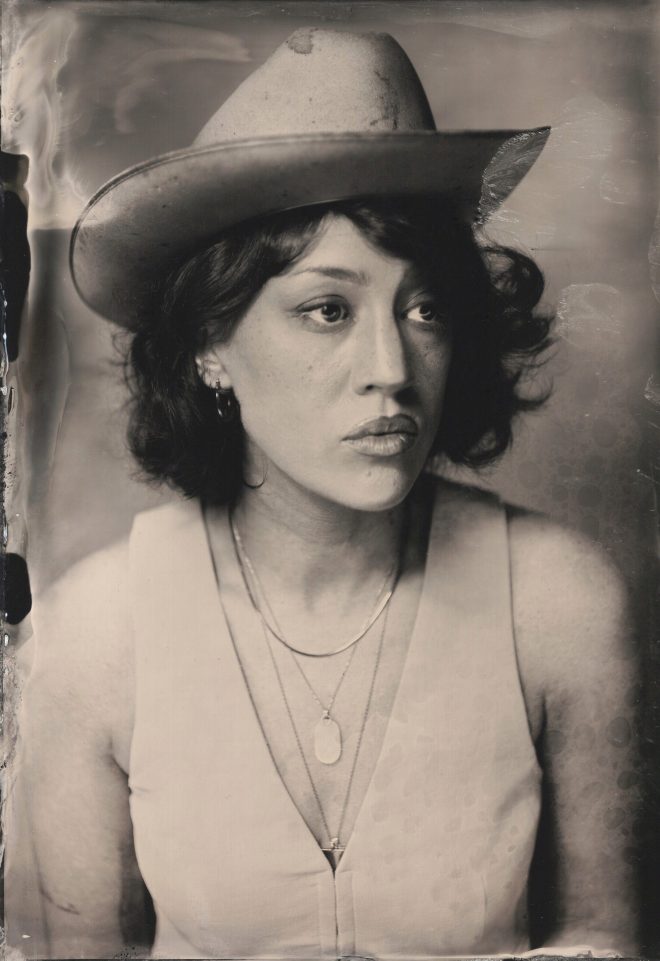
Matthew Nixson makes photos that last a lifetime and then some.
Tintyping, also known as “wet plate” photography, isn’t for the faint of heart. This style of photography requires complex chemical solutions, precise timing, and the patience to cultivate a single image over several days.
According to Matthew Nixson of Holliday Tintype, tintype is a method of developing a photo on a thin sheet of metal. It doesn’t have to be tin, necessarily; these photos were historically printed on blackened iron plates and, in the present day, can be produced on lacquered aluminum panels. The final image is monochromatic, presented in shades of gray, black, and white.
In the 1800s, when tintype was first patented, old-school cameras with bellows were used. The process can be completed today with modern instruments – Nixson says he prefers a Kodak or film camera. The image captured by the camera is cast onto a metal plate, which is prepared to transfer the blank photo emulsion.
It’s a delicate process. Salts, ether and cadmium are poured over the metal plate and gently manipulated to cover its surface until it reaches a syrupy consistency. Once the chemicals settle, the plate is submerged in a sensitizing bath containing silver nitrate and collodion, which renders it light-sensitive. (Nixson says he’s had to make peace with silver nitrate stains all over his clothing.) After exactly three minutes, the plate is removed and transferred to a photo box.
Nixson’s mobile darkroom equipment produces 4500 watts of light per second, activating the silver crystals to develop a negative image. That negative must be made light safe by “washing” it in total darkness, revealing the positive image. He wears a red light headlamp to see what’s he doing inside the mobile darkroom. Nixson later bakes the tintypes at low heat to solidify and preserve the imagery.
Nixson says tintypes are akin to family heirlooms because of their long shelf life – on average, a correctly prepared photo lasts for 100 years. The journey from tintyping student to full-time professional has been fulfilling for him. He’s proud of the talent he developed through time, trial, and error; recalling the first six months of practice when he ‘didn’t know what he was doing’ to finding mentors and collodion suppliers, teaching himself about aperture and film speeds, and becoming the accomplished tintyper he is today.
The variability of the art form is one of his favorite things about it; even with the same set of tools, the results can still be surprising. “Tintyping is a raw process, because of the light spectrum it’s using,” he explained.
The chemical recipes required to create a tintype can vary between photographers, but the common element is the moment when the negative image becomes a positive one.
“It’s a beautiful dance between magic and science. That few seconds where the photo turns light to dark – it keeps me doing this on days when it’s too hot and the ether is burning off faster than I can make the plates. Seeing people get excited about that moment is a beautiful part of the process,” Nixson shared.
Since getting into tintype, he has taken over 4,000 portraits and has turned his photography into a full-time travel business. “I made a completely new career at 38,” he said. “Don’t give up on your dream.”


Comments