How the West was Redone: Gazing into Tony Tost’s America

For decades, Hollywood polished a veneer over the legacy of Western expansion, churning out morality tales with archetypes like the Hero in White, the Villain in Black, the Noble Savage and the Wandering Stranger. New adventures each week where the bad guy gets his comeuppance and the cowboy rides away.
Cue: Marshall Dillon. Cue: The Lone Ranger.
Over time, those paradigms shifted and the formula evolved, embracing moral ambiguity of characters and spotlighting previously maligned Indigenous groups. The Western dominated the box office for decades and defined the cultural id of the United States in ways that still haven’t been fully unpacked. Even though Taylor Sheridan’s Saddled Up Soap Operas print money like the Federal Reserve, studios have been uneasy about funding Westerns in the modern era. Given the fickle nature of audiences, it’s a real crapshoot if you’ll end up with Django Unchained or Horizon: An American Saga at the box office. So, in an age of uncertainty, can a Western overcome the doomscrolling and streaming fatigue to touch audiences in a way they once did?
Tony Tost thinks so.
“The Western is a pretty eternal storytelling form,” he said. “Entertainment industry people in my experience come from mostly upper class, urbane backgrounds, so I think they constantly underestimate how popular the Western remains. My suspicion is that it’s less a recent resurgence than just Taylor Sheridan being stubborn and powerful enough to get things like Yellowstone on the air to serve an audience that had been under-served for a while.”
The filmmaker and part-time Fayetteville resident has worked off-and-on in the genre since his first job as a writer on A&E’s Longmire, a show that redefined the genre through the lens of a modern day Wyoming Sheriff out to get his man. Tost’s own show Damnation, which ran for one season on the USA Network, showcased the struggles of the American Labor Movement during the 1930s. Needless to say, he’s been building up to something big and Western.
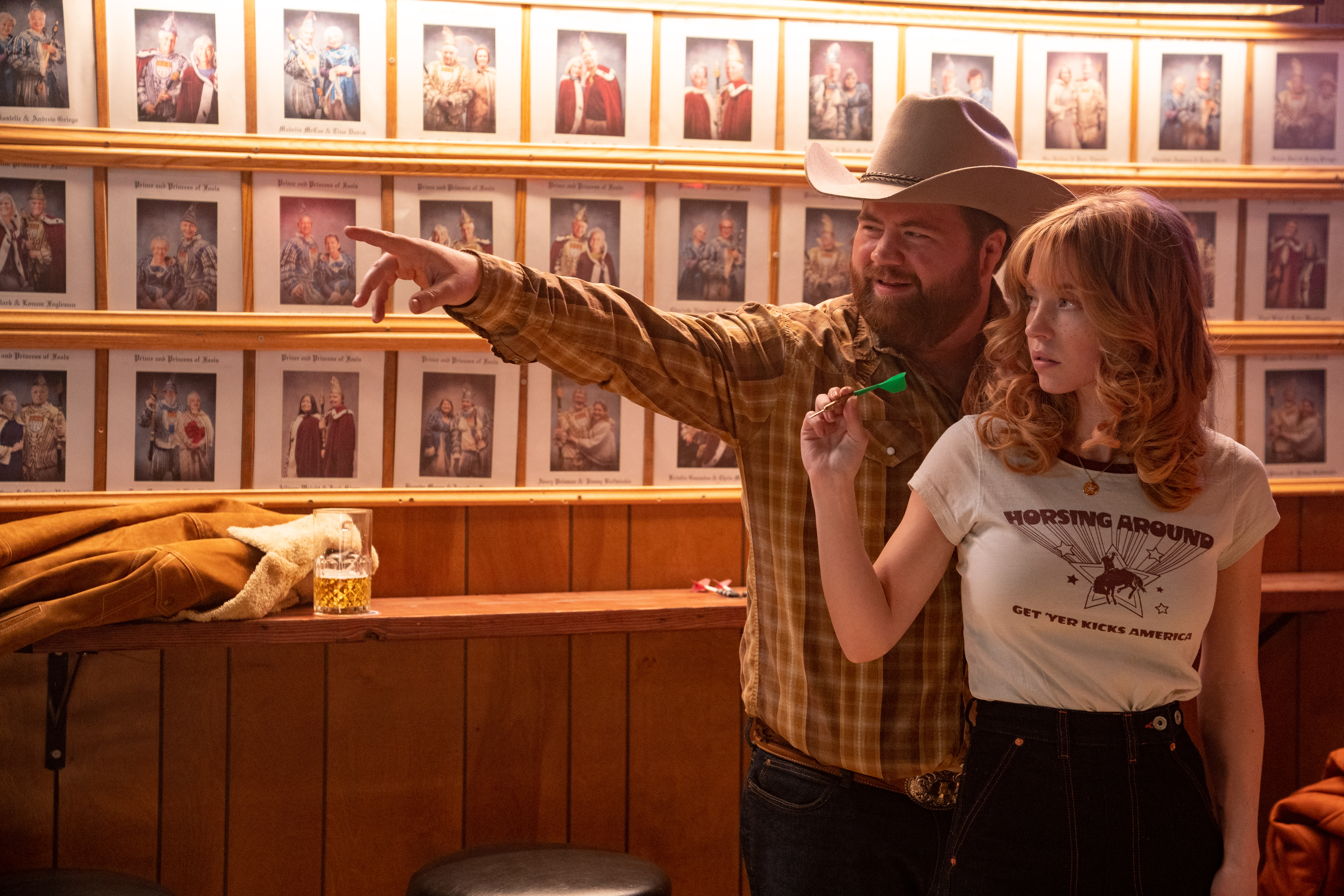
His debut feature film Americana stars Sydney Sweeney, Paul Walter Hauser, Halsey, Zahn McClarnon, Simon Rex and more. In Americana, the lives of local outsiders and outcasts violently intertwine when a rare Lakota Ghost shirt falls onto the black market in a small South Dakota town. This ensemble feature also blends genres by tucking the Western themes in a crime thriller structure with comedic undertones. It’s a film Tost has long wanted to make.
“I wanted to do a modern day Western in flyover territory, Tost said. “The first thing I came up with was this white kid, who’s growing up in the middle of nowhere in a trailer watching westerns. He is inspired by the Native Americans in the movie to kill his abusive stepfather. That was the seed for the whole thing.”
Growing up, Tost found himself much like the young character he envisioned – a lost, lonely kid at home watching Westerns in a rural, low-income area in Washington. He longed for a good, strong father figure, finding surrogates in Clint Eastwood and John Wayne on screen and George Strait and Johnny Cash on the radio. Western stories posed stark moral and ethical questions through the lens of weathered faces, Paint horses and arid landscapes. They pushed against his prior assumptions of what it meant to be a man.
“Westerns are a very American version of epic storytelling, folk storytelling, Greek myths,” he said. “The American West is traditionally a place outside norms of law and custom, so it’s a place to have bigger-than-life stories and characters in a setting where human nature and fate rule, as opposed to city ordinances and the logic of commerce. So much of what I both love and fear about America itself can be found in the Western: freedom, lawlessness, violence, self-reliance. I like that most characters in Westerns don’t talk about their feelings, but rather act on them. Many Westerns have huge operatic backstories involved that are just juicy and fascinating.”
Westerns sparked a broad love of cinema for Tost that continued as he attended the University of Arkansas’ Creative Writing MFA program to study poetry and later when he moved to Los Angeles to begin his career as a screenwriter. While he carried his love of films by directors like Sam Peckinpah and Sergio Leone, he embraced ensemble stories by the likes of Robert Altman and Paul Thomas Anderson, all of which influenced Americana in their own way.
The film’s journey to a nationwide release was not without its travails. Tost and producer Alex Saks worked diligently to get it off the ground for a few years by recruiting stars like Sweeney, Hauser, Halsey, Rex and Tost’s old Longmire pal McClarnon before pitching to studios for financing. Once the film was greenlit, Tost found production to be the easiest time in the process. He said, “I loved every second of it, and it was a lot of work. But I got lucky because of the uniformly cool cast. No assholes, no divas. Ditto on the crew. I was a first-time director, but everybody else on set was an expert in their role so that was good.”
Having served as showrunner for Damnation and most recently Peacock’s Poker Face, Tost prefers directing. He said, “It was kind of easier than showrunning because working in TV when you’re giving notes on set as a writer, producer or a showrunner, you’re almost directing the director to how you want things to go. So, when you’re directing a film, you’re cutting out the middle man.”
When Americana premiered at SXSW in 2023, Deadline declared, “Tony Tost turns the Western genre upside down.” After a solid debut, the film remained in limbo for a few years after the independent financier declared bankruptcy, delaying it until the Lionsgate release in mid-August of this year.
Breaking into the industry is a tough go for anyone, especially someone from a working class background. Tost hopes a film like Americana can bring a new perspective to the big screen. He said, “I’m hoping it’s a little bit of counter-programming because there’s not a lot of people with my small town, blue collar background who get to make films and TV shows and who unironically love Burt Reynolds movies.”
While the Smokey & The Bandit era may be long gone, Tost has managed to leave his mark on the silver screen with his directorial debut. And he did it for that kid he used to be, the one sitting at home alone gazing into the fuzzy screen of an old box television as Gary Cooper rode off into the sunset. For Tost, Westerns aren’t just a cheap cinematic rush, but remain an eternal form of storytelling.
“The great thing about Westerns is that they’re so pliable,” he said. “You can just tell a good story. Or you can use the mythic structure of the Western to handle contemporary anxieties in an exciting form. A modern day Western like Hell or High Water — one of my favorite movies — works because it not only dramatizes the modern West in an interesting way, but it also pulls the history of the West along with it in its telling. But I don’t think movies have to reflect the state of our culture, generally. I’d prefer it if more movies just focused on trying to tell an interesting story instead.”
IG: @TONYTOST
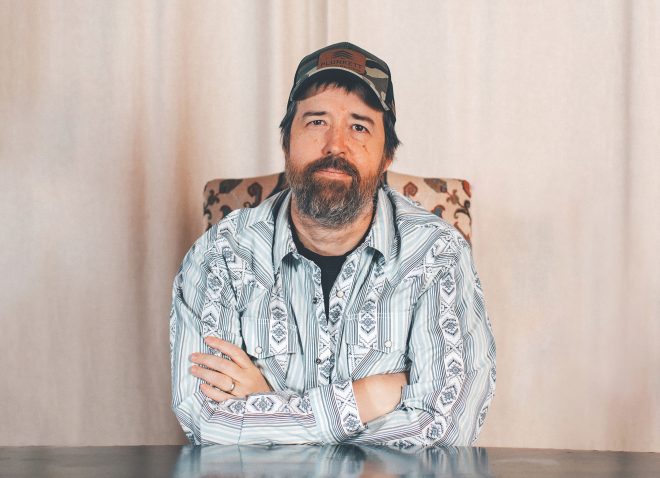
Tony Tost Portrait by Kat Wilson

Previous Story
It's a Wrap: A Look Back at Filmland 2025
Next Story
Arkansas Music Week Reverberates Through Fayetteville



Comments