Arkansas Women to Watch 2026: Words Become Matter Exhibition Examines Books as Objects, Structures, and Experience

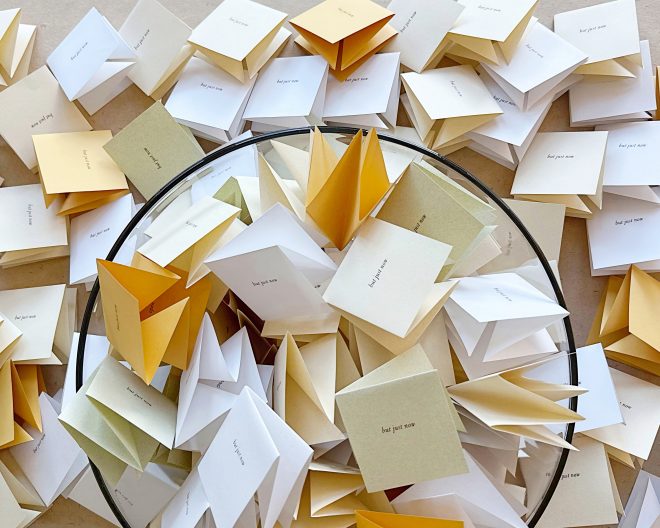
Words are often treated as carriers of meaning – read, interpreted, and set aside. In the Arkansas Women to Watch 2026: Words Become Matter exhibition, presented by the Arkansas Committee of the National Museum of Women (ACNMWA), language takes on physical form. Folded, printed, stitched, mailed, cut, and constructed words move beyond the page to become objects that invite close looking, touch, and participation.
“Three Arkansas artists have been selected for their innovative approaches to the book as art,” said Demara Titzer, President of ACNMWA. “Their work pushes beyond traditional bindings and printed pages, reimagining words as material that can be folded, stitched, carved, and constructed into new dimensions. Each artist demonstrates how language can be embodied, and how words themselves become matter.
The exhibition of contemporary book art features artists K. Nelson Harper of Fort Smith, Acadia Kandora of Fayetteville, and Rebecca Resinski of Conway. Starting in February, Arkansas Women to Watch 2026: Words Become Matter will travel to five venues across the state stopping in Little Rock, Blytheville, Pine Bluff, Batesville and Fort Smith, partnering with museums, colleges and arts organizations along the way.
Arkansas Women to Watch 2026: Words Become Matter focuses on artists’ books and book-based artworks that move beyond traditional formats. The featured artists use text, structure, and material to explore how language can function as a physical form. Their work invites viewers to consider books not only as vessels for reading, but as visual and tactile objects.
“Artists who work with words may press them, paint them, fold them or mail them, so that a text becomes a three dimensional object – not the usual book, but an object that carries word,” said MaryRoss Taylor, Exhibitions Committee Chair for ACNMWA. “Invited curator Catherine Walworth, the Jackye and Curtis Finch Curator of Drawings at the Arkansas Museum of Fine Arts, surveyed the state to choose three artists who take different approaches – all the more fun for audiences. We can look closely to get the words, and also admire the artful shape.”
Walworth’s curation of the exhibition brings together three distinct approaches to book art. While each artist works differently, all three challenge expectations about the relationship between words and form, emphasizing how meaning can emerge through materials, process, and structure.
THE ARTISTS
- Nelson Harper (Fort Smith)
K. Nelson Harper works within the genre of the artist’s book, drawing on a background in photography, printmaking, graphic design, creative writing, and reading. Harper writes that the medium “allowed me to call upon my background…to bring life to books as an art form,” with the goal of engaging the reader “not only with words, but also visually and tactilely.”
Harper notes that “digital printing and delivery methods have freed up the physical book to become something much more than a vehicle for imparting information.” Across Harper’s practice, material choices and printing processes are selected to best serve the concept, with the guiding principle that “in my books, the text is boss, and I merely carry out its demands.”
Acadia Kandora (Fayetteville)
Acadia Kandora’s work combines printed matter, collaborative publication, sculpture, and community-based projects that examine humanity’s relationship to nature. Her practice explores “nature as armor, nature as sanctuary, and the intersection between the imaginary and the concrete,” informed by deep ecology, the theory of indistinguishability, and glitch as a form of disruption.
Kandora’s studio practice is grounded in time spent outdoors, where she observes and collects material for an extensive archive. From this archive, she deconstructs and alters imagery to create prints, publications, and sculptural objects. Her sculptural works incorporate cut, twisted, and folded publication imagery to form reimagined plant structures, embedding fragments of narrative within physical form. Kandora also maintains a public-facing practice centered on collaboration and empowerment, including projects such as the Community Zine Garden Project, a mobile zine-making station installed in a local park.
Rebecca Resinski (Conway)
Rebecca Resinski designs, creates, and distributes pamphlets under the imprint Cuckoo Grey, a one-person workshop devoted to experimentation with form, content, and reader interaction. Through pamphlet-making, Resinski explores “the relationship between form and content…inviting [the reader’s] seeing and thinking to complete a pamphlet.”
Resinski connects the pamphlet to historical traditions of accessible publishing, working with modest tools such as a laser printer and readily available materials to focus on interaction rather than spectacle. Her pamphlets are offered free of charge and circulated through the mail, reaching a wide audience. Influenced by her background as a professor of Classics, Resinski’s work reflects an interest in how texts travel across time and space, and in the ongoing dialogue between historical book forms and contemporary practice.
The exhibition is part of the National Museum of Women in the Arts’ Women to Watch program, which supports women artists through regional exhibitions across the United States and abroad. One artist from the Arkansas exhibition will be selected to represent the state in Women to Watch 2027: A Book Arts Revolution, a major exhibition at the National Museum of Women in the Arts in Washington, D.C., opening in April 2027.

Previous Story
RED, WHITE AND YOU: Kat Wilson Celebrates America’s 250th Birthday with a New #SELIFETHRONE
Next Story
The 2026 El Dorado Film Festival brings nationwide talent to South Arkansas


Comments