It’s a Wrap: A Look Back at Filmland 2025

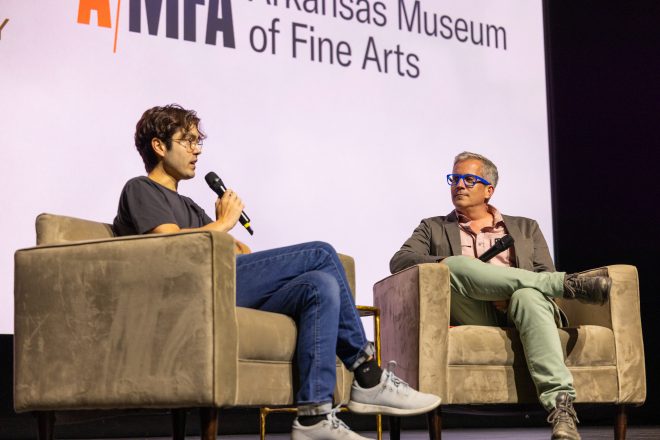
Arkansas Cinema Society hosted its annual celebration of all aspects of film via Filmland August 13-17 at the Arkansas Museum of Fine Arts in Little Rock. The five day event was described as the biggest and best Filmland yet by ACS Executive Director and Founder Kathryn Tucker.
New at Filmland:
This year’s Filmland rolled out, for the first time ever, a pitch contest, where emerging filmmakers were able to pitch their original short film ideas to a panel of industry professionals. This year, the winner of the $5,000 film equipment grant from Film Gear Rentals, mentorship and the chance to premier their finished film at next year’s Filmland was “ “.
Another unique feature was Variety’s top 10 Storytellers to Watch, which was moderated by Variety’s Peter Debruge, who explored conversation with five of the 10 emerging storytellers. Those in attendance included Holly Brickley, Sophia Gibber, Tembi Locke, a.k. payne and Josh Sharp – all of which have bright futures in the industry. The full list is available on Variety’s website.
This year’s lineup:
With the conclusion of this event ending with Sundance Next Innovator Award-winning “East of Wall,” the five day event showcased local and national talent, at home in Arkansas.
Ranging from showcased short films such as “Godhead,” to genre-defying longform works such as “East of the Wall,” which won the Sundance Next Innovator Award, this year’s lineup offered something for all filmmakers, aspiring filmmakers and cinephiles to enjoy.
While each screening offered something special to the audience, a few of the show-stoppers included “Twinless,” “Tow,” “The Last House” and “Abigail Before Beatrice.”
Twinless
Friday night’s feature was James Sweeney’s “Twinless.” Completely genre-bending and defying what some may call typical, this movie was more or less an exploration of grief through the guise of comedy, suspense and, at times, thriller-esque qualities. Starring both Sweeney and former “Teen Wolf” star Dylan O’Brien, this film follows Roman (O’Brien) and Dennis (Sweeney) through navigating life without a twin. With unexpected twists and turns throughout the duration of this cinematic masterpiece, this movie could make any curmudgeon laugh, cry and even grieve alongside these complex characters.
It would be criminal to not mention that Lauren Graham, known best for her role as Lorelei on “Gilmore Girls” stepped back into a motherly position in this film as well. While this is not Sweeney’s debut project, “Twinless,” was casted to perfection, and served as a great introduction to Sweeney’s writing, directing and acting abilities. According to Sweeney, who previously directed “Straight Up,” much of the inspiration of this film came from his desire to create something completely different and wholly his. Sweeney also leaned into his own fascination with twins and background in psychology to bring not only his character, but the entire script, to life.
“I grew up in an era where twins were very much part of my cultural zeitgeist. Mary Kate and Ashley Olsen, ‘Sister, Sister,’ ‘The Parent Trap.’ There was something about the intimacy and the idea of a perfect best friend who shares your face and your thoughts and your feelings that was very appealing to me,’ Sweeney said. “…in my early twenties I dated an identical twin and I wrote the first draft shortly after he broke up with me.”
While the movie relies more on what Sweeney has dubbed “emotional truth,” rather than actual truth, the audience can thank his upbringing in the so-called age of twins for this work of art.
“Twinless” is now showing on the big screen.
Tow
Based on the true story of a homeless Seattle woman fighting for her car back, “Tow,” stars Rose Byrne, who plays the film’s lead, Amanda Ogle. Tackling topics ranging from poverty to legal injustice to homelessness and addiction, the film, which is directed by Stephanie Laing, examines the resiliency of the human spirit when faced with challenge-after-challenge-after-challenge.
Also starring Octavia Spencer (Barb) and Demi Lovato (Nova), the film is stacked with memorable lines, characters who may appear to be underdeveloped and an unbelievably frustrating fight against a tow company.
In lieu of a Q&A with Laing, who could not make it to the screening due to unforeseeable circumstances, Jayme Lemons read a letter written by Laing, which examined key parts of the filmmaking experience.
“When I first read the screenplay for ‘Tow,’ I knew I had to tell Amanda’s story, and I knew it had to be Rose Byrne. Thankfully Rose felt the same way. Casting was the easy part of making this film. Octavia, Ariana, Demi and Dominic all opened their hearts and poured so much love into their characters,” said. “The hard part was raising the money for a drama about a woman fighting a broken system. We took on the fight against what some may say is also a broken system and we made this film anyway. Having met with Amanda, Kevin and Avery, the characters you will shortly meet, there was simply no way we were not going to bring their story to the world.”
While many may remember the national story of Amanda Ogle, this movie really brings out the struggles that Ogle was facing prior to her story being told. As told on-screen, Ogle was experiencing homelessness, compounded by alcoholism, and was at a job interview when her car, which was also her home, was stolen.
According to Laing, Ogle is a fighter who never gave up, and she still hasn’t. The movie may be the story of Ogle, but on a deeper level, it is also an examination of the power of community and kindness.
Laing also said that most people she knows right now are barely getting by, and at least five people on the crew of the film had, at one time, lived in their cars.
“‘Tow’ sheds a light on the housing crisis, and my hope is that it furthers talks toward solutions,” Laing said in her letter to the audience.
While the vehicle was later recovered, it was towed to a business requiring payment for release. Without a way to get to work, or a sure place to lay her head at night, Ogle was left to clean up the pieces of her crumbling existence.
The movie is nothing short of inspiring, largely because the real-life story was also nothing short of an inspiration. To others, a car may not have been worth the extensive battle, however, to this mom, the car was everything.
The Last House & Abigail Before Beatrice
Among several short stories screened throughout the event, “The Last House,” directed by Arkansas native Damon McKinnis, has a lot to say. Following two criminals, Max and Dee, as they make a trip to an elderly woman’s illustrious home for a daytime burglary, the short film dives deeper into the motivations behind the inherent criminality and approval-seeking behavior from the film’s leads.
While the short film is about criminals doing criminal things, it is more so about the relationships harbored through friendship with coworkers (or co-conspirators) and the lengths that loved-ones may go to in order to create a better future for those they hold close.
The film, which recently wrapped, was the winner of the Panavision New Filmmakers Grant in 2022, and was made possible by Arkansans supporting filmmakers.
Immediately following “The Last House,” screening, Cassie Keet’s “Abigail Before Beatrice,” played, leaving the crowd to enjoy an eerie Sunday afternoon full of suspense.
“Abigail Before Beatrice” was made with a local crew, something Keet was grateful to be able to do.
“One of the things that I wanted to do most when making this movie was shoot in Arkansas, because shooting locally and having a local crew means so much to keeping film in Arkansas alive and what really matters is to make sure film stays here in Arkansas,” Keet said, expressing the importance of rallying behind lawmakers to raise the spending cap to allow for more Arkansas artists to work with talented crews for local projects.
Set in rural Arkansas, the film follows Beatrice (Olivia Taylor Dudley) through her semi-isolated lifestyle including trespassing to pick strawberries, jam-making and seemingly recovering from something more nefarious and stranger-than-truth.
As is ingrained in Southern Gothic culture, cults remain a topic of interest to many, and for few, such as Beatrice, an unbelievable reality. Led by Grayson (Shayn Herndon), the cult exists on a local farm, where he and his many wives suffer the escalation of his unraveling under the manufactured power he possesses. The movie walks the audience through Beatrice’s current reality, as well as glimmers from the protagonist’s past, where Abigail, among others, is introduced. As Beatrice clings to her beliefs, the world around her rejects the idea, leaving her to mourn her family and cope with the reality of the situation.
While there are no words for the unexpected outcomes in this movie, there is a familiarity within it, which may be appealing to those interested in the psychology behind cult leaders, and the followers they keep after being exposed.
MORE INFO AT FILMLAND.ORG

Previous Story
10th annual ACANSA Arts Festival of the South returns
Next Story
How the West was Redone: Gazing into Tony Tost's America




Comments