Small Worlds, Deep Lore: The Rise of Story-Driven Indie Video Games in Arkansas

A nascent industry is emerging in Arkansas. Independent video game creators are crafting new stories and experiences that are personal and intimate, and which take inspiration from local traditions.
“We’re really trying to build awareness that there are people here in Arkansas making video games that are inspired by things like Ozark folklore,” said Kjartan Kennedy, Studio and Technical Director at Causeway Studios. Their latest release is “The Haunting of Joni Evers,” which they describe as “a psychologically thrilling adventure-strollplayer that tells an emotional story of estranged family underscored by a malevolent, inter-dimensional haunting.”
“The Haunting of Joni Evers” uses a supernatural setting to explore universal experiences, like feelings of abandonment and grief. The game currently sits at a 92% positive rating on the Steam Game Store, and was the recipient of several Collision Awards, recognizing the game’s achievements in narrative and voice performance. Kennedy said he thinks that all aspects of game design require making artistic decisions, and that collaborating on a final product is similar to other artistic pursuits.
“Our games are a product that is greater than the sum of its parts, so everybody’s bringing something to it. And then when we start to sort of riff off of each other, it’s like a band, it’s like a jazz collective in that somebody will come up with something and somebody else will riff off of that, and then somebody else will remix it in a new and interesting way and add their own little twist on it,” Kennedy said.
Brain&Brain is another local studio creating in the indie game space. The studio is made up of husband and wife David and Brooke Condolora. Their most recent release is “Burly Men at Sea,” which plays as a choose-your-own-adventure storybook inspired by Scandinavian folklore. The player controls the titular trio—the Brothers Beard—through interactive illustrations and animations brought to life with a capella sound effects. The reserved deployment of color and minimalist design are highly stylish, and place the title among the increasingly popular genre of the “cozy game.”
Brooke Condolora said that one reaction to the game took her by surprise: that her game was a source of healing.
“It was unexpected, because we didn’t set out with that as a goal: we just turned our insides out and put the best of that into the game. For players to respond in that way really gave us an awareness of how much of an impact what we make can have on others. That’s a huge responsibility. I think it’s easiest to perpetuate darkness, but if we can bring light and healing, that’s what I’d like to reach for,” Condolora said.
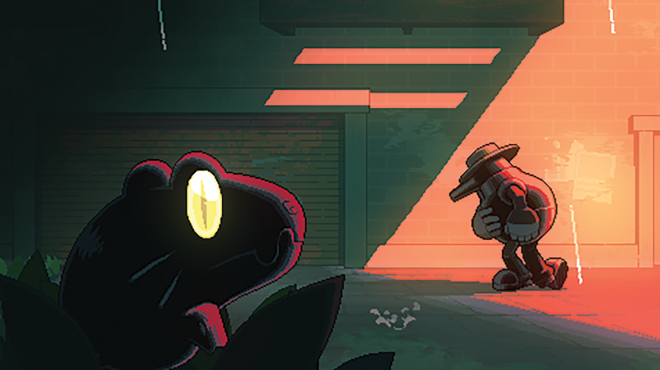
If brush strokes are the vocabulary of the painter, what form is specific to video games that give the medium its particular voice? Addy Valentine is a local pixel artist, video game designer, and video essayist who uses his Youtube channel to showcase his own games and to give perspective on elements of game design. He is a master of pixel art, referring to the arrangement of pixels on a grid that originated from the early limitations of computer hardware but now has recognition outside games (see street artist Invader) and has remained popular even as graphics have approached photo-realism. Pixel art instantaneously communicates this is a video game, and is arguably the medium’s most recognizable form.
“Pixel art is a very intentional art style. Much like pointillism, the artist needs to place almost every pixel by hand…It’s one of those few art styles that you can look at and tell that someone had to place each individual pixel,” Valentine said. “You look at pixel art and you know you’re looking at a game.”
Valentine is currently working on the game “Gun Nose,” a top-down action RPG reminiscent of the sci-fi noir Blade Runner, which deploys pixel art in a unique fashion.
“I’m experimenting with using pixel art in a 2D animation pipeline for things like cutscenes, as well as trying to render the game world to be a 3D kind of pixel art that still retains its fidelity from every angle,” Valentine said.
Causeway Studios and Brain&Brain also have games currently in production. Causeway studios are working on an unnamed title that is internally referred to as “Project Red.” The game takes inspiration from the films of David Lynch, the video game Alan Wake, and the music of Lord Huron. Brain&Brain are working on “The Marvelous Raincaster of Yell Holler,” which takes inspiration from Condolora’s memories growing up in rural Arkansas, Vance Randolph’s book “Ozark Culture and Folklore,” and the story of real-life rainmaker Charles Hatfield.
CAUSEWAYSTUDIOS.COM / OZARKGAMES.DEV / BRAINANDBRAIN.COM / ADDYVALENTINE – YOUTUBE

Previous Story
The 2026 El Dorado Film Festival brings nationwide talent to South Arkansas
Next Story
ARTx3 Campus announces robust March lineup



Comments